Italy · Tuscany
Florence
The Renaissance, still in residence.

In season · April · May · September · October
Behind a good many unmarked doors in this city, somebody is still making something by hand. Gold leaf, marbled paper, bookbinding, frames, shoes, restoration work on objects older than most countries — the trades that supplied the Renaissance never entirely stopped. They operate now in the same narrow streets they always did, a few minutes and an entire world away from the queues.
Stays · Florence
Where to stay

Splurge
Helvetia&Bristol Firenze – Starhotels Collezione
five-star historic hotel
A five-star hotel of real age a short walk from the smart shopping street, with a spa, a hammam, an indoor pool and a restaurant. The rooms are the traditional Florentine kind — heavy fabrics, painted ceilings — rather than a modern reinterpretation of them.
spa and wellness centreindoor poolhammamrestaurantfitness centre
Rates on request

Mid-range
Porta Rossa Hotel Firenze, Colbert Collection
five-star historic hotel
A five-star hotel occupying one of the oldest continuously used lodging buildings in the city, on a narrow street between the main square and the river. Everything in the centre is a short walk from the door.
restaurantbarconciergeroom servicevalet parking
Rates on request
Good value
Hotel Bodoni
two-star hotel
A two-star hotel in the Santa Croce quarter with a lift, a roof solarium and a bar, a walk from the basilica and the leather workshops. Simple rooms in a part of the centre that still functions as a neighbourhood after the day visitors leave.
sun terracesolariumbarlift24-hour front desk
Rates on request
Search every stay in Florence with your datesCompare prices on Trip.com
Looking for a private house rather than a hotel? Tell the desk your dates and your party.
Booking links are affiliate links: if you book through one, we may earn a commission at no extra cost to you. Map data © OpenStreetMap contributors.
Experiences · Florence
Worth booking ahead

Craft & design · Splurge
Artisan Workshops: Private Walking Tour in Florence
with Artviva The Original & Best Walking Tour
A guided walk between working craft studios — carved wood, mosaic, sculpture — meeting the people at the benches rather than looking at finished work in a window. Pieces can be bought directly from the makers.
3 hoursPrice on request

Food & wine · Mid-range
Walking Food Tour of Florence with Tastings and Wine
A guided eating walk through the central quarters with stops for tastings and wine along the way. It works best early in a stay, because it settles where you will want to go back to eat properly.
From €99 a person · checked September 2026

Guided museum visit · Good value
Florence Accademia Gallery Tour with Entrance Ticket Included
A guided visit to the gallery that holds the David, with timed entry included so the queue outside is not part of the morning. Short, and an efficient hour of art.
1.5 hoursFrom €48 a person · checked September 2026

Guided museum visit · Splurge
Palazzo Vecchio Secret Passages Tour
A guided walk through the private passages built inside Palazzo Vecchio so the Medici could move through the palace unseen. Booked as a timed entry with a guide rather than a standard ticket.
From €27 a person · checked September 2026

Museum entry · Mid-range
Combo Uffizi Gallery plus Accademia Gallery
One booking covering both galleries on the same date, with the time slot chosen at purchase. The two collections are a short walk apart and are usually the pair a first visit is built around.
From €20 a person · checked September 2026

Museum entry · Good value
Uffizi Gallery Tickets plus Archaeological Museum Access
Timed entry to the Uffizi with access to the Archaeological Museum included. A light way in for a visitor who wants the collection without a guide.
From €9 a person · checked September 2026
Booking links are affiliate links: if you book through one, we may earn a commission at no extra cost to you. Prices are as checked on the date shown and vary with party size and season.
A city that kept its trades
Most historic centres have been hollowed out and refilled with shops selling the same things. Florence has lost ground to that as well, though the workshops have held on. Cross the river into the older artisan quarter and the ground floors change character: benches, tools, the smell of glue and leather, doors open onto rooms that have clearly been rooms of that kind for a very long time.
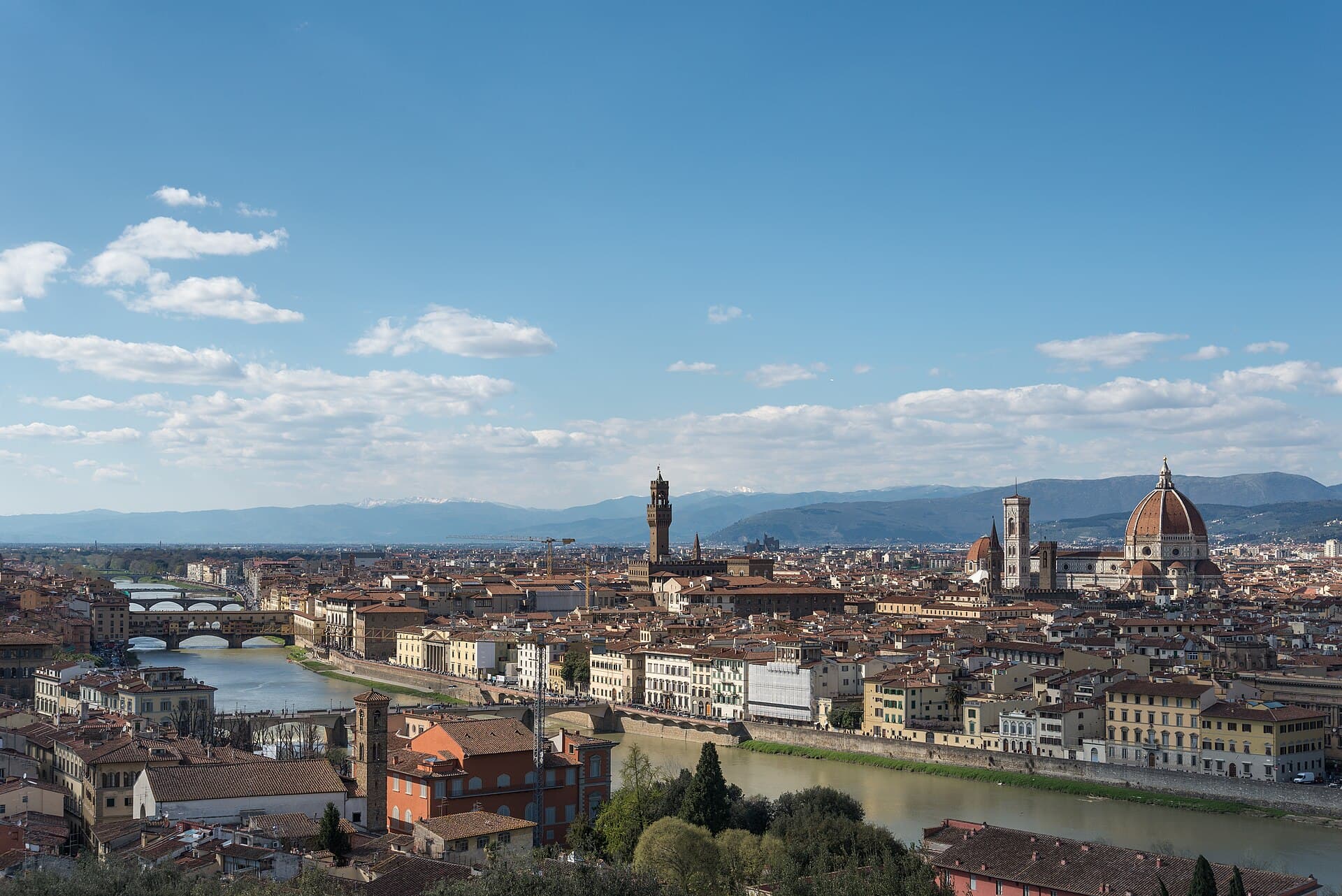
Seek this out early in a stay, because it recalibrates everything that follows. The paintings and the architecture stop being a heritage exhibit and start looking like the output of a city that made things for a living and never really stopped. The dome is not a monument in that reading. It is a workshop culture at full stretch.
When to come
April, May, September and October are the months to aim at. Florence sits in a river basin ringed by hills, which does it no favours in high summer — heat settles in and stays, and the centre is crowded exactly then. Spring and autumn give warm days, cool evenings and a city you can walk around in comfortably.
Couples do well treating the centre as an evening city and a morning one. Days belong to visitors; the hours around dawn and after dark belong to everyone else. Rooftop terraces are the local answer to the middle of the day, and they are worth the small ceremony of finding one.
Whether it is expensive
Less than its reputation suggests, with a sharp gradient. The compact historic centre commands a premium because everyone wants to sleep inside it, and the streets around the main sights are priced for people who booked late and did not compare.
Step across the river, or a few streets out from the centre, and the same city becomes markedly better value while remaining entirely walkable — this is a small place, and almost nothing is far. Eating follows the same rule: a menu in three languages beside a major sight will cost you more than a room full of locals ten minutes away. Given how much the centre's rates swing with the season and the calendar, comparing current stay and experience options across a spread of dates is straightforwardly worth the effort.
What is worth paying for
Skipping the queue, wherever that is possible. The major collections reward planning ahead, and the difference between a booked entry and an unbooked one is measured in hours of your holiday.
Beyond that, spend on a guided hour or two with somebody who actually knows the material — the art here is dense with argument and reference, and half of it is invisible without a translator. And spend on the workshops: something made by hand in the quarter it has been made in for centuries makes a good souvenir.
Where to stay
Splurge
A converted palazzo in the centre with frescoed ceilings, a courtyard and a rooftop terrace looking across the tiled roofs to the dome. These are grand, quiet buildings hiding behind plain façades, which is very much the local manner. Right for travellers who want the city at its most formal and everything within a short walk.
Mid-range
A small design-led hotel or a restored townhouse just outside the busiest streets, often across the river, with a courtyard garden and a proper breakfast. Comfortable, characterful, and ten minutes on foot from everything that matters. A sensible base for couples who intend to walk the city rather than look at it from a window.
Good value
An apartment in a residential quarter beyond the centre, where the market is a real market and the bar downstairs serves the same people every morning. You trade the address for space and a neighbourhood. Ideal for anyone staying long enough to want a routine.
Florence at a glance
| Detail | Florence |
|---|---|
| Country | Italy |
| Region | Tuscany |
| Character | Renaissance capital, artisan quarters, rooftop terraces |
| Best months | April, May, September, October |
| Aspirational tier | Converted palazzo in the centre, courtyard and rooftop terrace |
| Mid-tier premium | Small restored townhouse or design hotel, often across the river |
| Entry-level | Apartment in a residential quarter beyond the centre |
In Frame · Florence


Before you go
Planning Florence
Enquire
Planning Florence?
Tell us roughly when and how many of you, and we will reply by email. We only pass your details to an operator if you ask us to.