Italy · Liguria
Cinque Terre
Five villages stitched to the cliffs by footpaths and vines.

In season · May · June · September
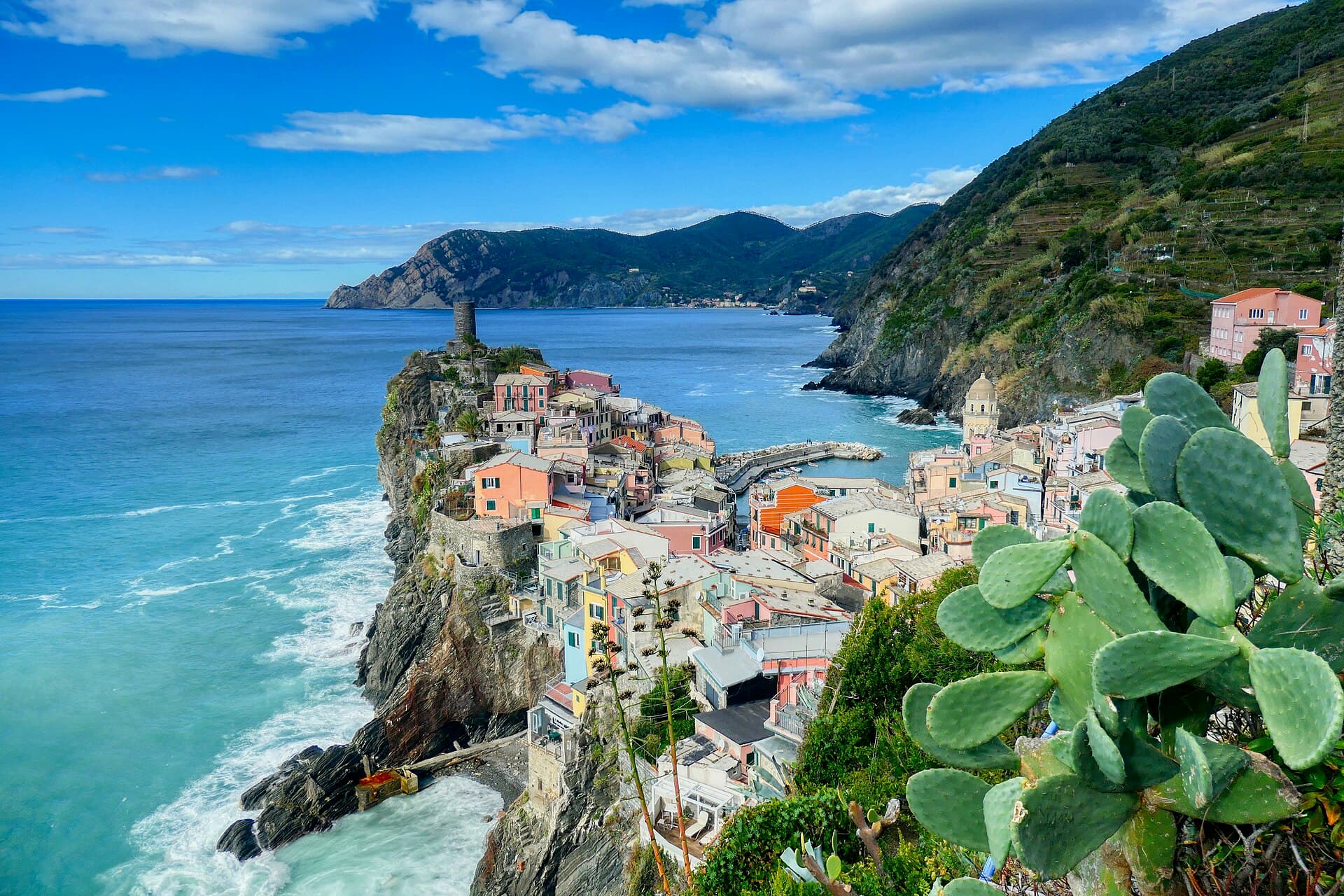
For most of their history these villages could not reach one another by land. Headlands drop straight into the water between them, and until a railway was driven through the rock the honest connections were a boat or a mule track over the shoulder of the hill behind. That is why five separate places grew up along one short stretch of coast instead of a single town, and the separation still shows in how little they resemble each other. What they share is a building style, a wine made on the terraces above them, and a shortage of flat ground.
Stays · Cinque Terre
Where to stay
Splurge
Arpaiu
rooms and terraces above the Manarola harbour
A converted house on the slope above Manarola, arranged around terraces that look down the vineyard rows to the water. Breakfast is brought to the room and the harbour steps are minutes below.
sun terracebeachfrontconcierge servicemassageshared lounge
Rates on request
Mid-range
La Casa sul Mare
beachfront rooms in Monterosso
Rooms on the seafront at Monterosso, the one village of the five with a proper beach in front of it. A shared sun terrace faces the water and the station is on the same side of town.
sun terracebeachfrontshared loungeair conditioningluggage storage
Rates on request
Good value
Affittacamere Le Terrazze
guest rooms with terraces in Corniglia
Simple rooms with terraces in Corniglia, the only village of the five that sits above the sea rather than on it. There is a garden, and the walking routes in both directions start at the door.
gardensun terracestreet parkingair conditioningluggage storage
Rates on request
Search every stay in Cinque Terre with your datesCompare prices on Trip.com
Looking for a private house rather than a hotel? Tell the desk your dates and your party.
Booking links are affiliate links: if you book through one, we may earn a commission at no extra cost to you. Map data © OpenStreetMap contributors.
Experiences · Cinque Terre
Worth booking ahead

Private boat charter · Splurge
Cinque Terre Private Boat Tour with Aperitivo
with Sea Breeze Boat Tours
A private boat along the five villages from Monterosso or Levanto, with swimming stops, snorkelling gear and an aperitivo aboard. Seeing the villages from the water gives a view the train and the paths cannot.
Price on request

Private boat tour · Mid-range
Private Boat Tour in Cinque Terre from Monterosso
A shorter private run from the Monterosso pier along the coast and back. It suits a morning when a path section is shut or the day is too hot to walk.
2 hoursPrice on request

Small-group boat tour · Good value
Cinque Terre Hybrid Boat Tour from Monterosso
A shared trip along the coast in a hybrid boat that runs quietly close in. It leaves from the Monterosso pier and takes in the villages from the sea.
3 hoursFrom €119 a person · checked September 2026
Booking links are affiliate links: if you book through one, we may earn a commission at no extra cost to you. Prices are as checked on the date shown and vary with party size and season.
Five villages that decline to be one place
Choosing where to base yourself is a decision that really matters here, because the villages are not interchangeable. One has sand and a promenade and feels like a small resort. Another is a working harbour with boats hauled up into the square. A third sits high above the water with no harbour at all. Read the character of each before booking, because a stay in the wrong one produces a mild, persistent sense of having missed the point.
What links them is worth understanding too. A railway line stitched through the headlands surfaces at each village in turn, and boats run the coast in the warm months. Footpaths also connect the villages, some along the cliff and some climbing over the shoulder of the hill behind, and they are a reason to come. Sections close from time to time after heavy weather, so check before assuming a route.
The terraces are the landscape
Every slope above these villages has been cut into steps and held up with stone walls, generation after generation, so that vines could be grown on ground that has no business supporting agriculture. Nothing here is decorative. The whole visible landscape is an enormous piece of labour that happens to be beautiful, and walking it teaches you a great deal about the place.
When to come
May, June and September are the months that work. Heat on an exposed cliff path in high summer is a genuine problem, and the villages themselves become uncomfortably full. Late spring gives green terraces and long light for walking; September gives warmer water and a slightly calmer coast.
Couples usually do better staying overnight than visiting for a day. Everything shifts once the last trains and boats have gone: the harbours empty, tables come out, and the villages briefly belong to the people who live in them.
Whether it is expensive
Costs here run higher than the modesty of the buildings suggests, and the reason is supply. These are small villages hemmed in by protected land, with no room to build, absorbing a great many visitors. Rooms are correspondingly scarce and correspondingly priced.
You have real levers, though. A room without a sea view, in a village further from the busiest, or up the slope rather than on the harbour, changes the picture substantially. Basing yourself in one of the larger towns at either end of the line is a real saving and costs you only the evenings. Because availability is so tight and varies so much by village, comparing current stay and experience options across your dates is worth doing properly here.
What is worth paying for
The paths, and the time to walk them slowly — though walking here is not simply free. The coastal sections linking the villages sit inside a national park and carry an entry ticket, while the higher routes over the shoulder of the hill are generally open ground and quieter for it. Beyond that, a boat trip along the coast, because the villages make sense seen from the water — you finally understand why each one sits exactly where it does. Sand is scarce along this shore, so swimming mostly means rocks, ladders and clear deep water.
Where to stay
Splurge
A small clifftop hotel or restored villa set above one of the villages, with a garden, a terrace and a view down the coast. There are very few of these and they book far ahead. Right for travellers who want quiet, a view and a short walk down into village life whenever they choose.
Mid-range
A harbour-front room or small guesthouse inside one of the villages, simple, well kept, with shutters that open onto noise and colour. You are in the middle of everything, which is the point and occasionally the drawback. Good for couples who intend to walk all day and want dinner downstairs.
Good value
An apartment or family guesthouse in a village up the hill, or in one of the towns beyond the park boundary. Space and value improve markedly and you lose immediacy. Ideal for anyone treating this coast as walking country with villages attached.
The coast at a glance
| Detail | Cinque Terre |
|---|---|
| Country | Italy |
| Region | Liguria |
| Character | Five cliff villages, terraced vineyards, coastal paths |
| Best months | May, June, September |
| Aspirational tier | Clifftop hotel or restored villa above a village, garden and terrace |
| Mid-tier premium | Harbour-front room or guesthouse inside one of the villages |
| Entry-level | Hillside apartment, or a base in a town beyond the park |
In Frame · Cinque Terre


Before you go
Planning Cinque Terre
Enquire
Planning Cinque Terre?
Tell us roughly when and how many of you, and we will reply by email. We only pass your details to an operator if you ask us to.